The honest answer is further than you think and less than you hope.
A reasonably active adult walking on flat, even ground at a comfortable pace covers about five kilometres an hour. Give that person eight hours and the arithmetic says forty kilometres. Almost nobody does forty kilometres. The number that shows up in practice, for people who are not specifically training for distance, sits closer to twenty.
The gap between the arithmetic and the reality is the interesting part. It is where the actual limits live, and most of them are not fitness.
The Realistic Numbers
Distance depends almost entirely on context. These are the ranges that hold up for someone in ordinary condition, not in training, walking a full day and expecting to walk again tomorrow.
| Context | Realistic day | What sets the ceiling |
|---|---|---|
| Flat path, light load | 25 to 35 km | Time and boredom |
| City sightseeing on pavement | 15 to 22 km | Surface hardness and standing time |
| Rolling trail, day pack | 15 to 20 km | Elevation gain |
| Steep or technical terrain | 8 to 14 km | Ascent and descent, not distance |
| Multi-day, consecutive | 60 to 75 percent of the above | Cumulative fatigue |
The last row is the one people plan around least and regret most. A distance you can do once is not a distance you can do four days running.
What Actually Sets the Limit
Elevation, not distance
Ascent is the most expensive thing your legs do. As a working rule, every 100 metres of climbing costs roughly what an additional kilometre of flat walking costs, and steep descent has its own price paid in a different currency.
This is why a fifteen-kilometre mountain day can be harder than a thirty-kilometre valley day. Route profiles matter more than route lengths. Read the elevation graph before you read the number.
More on this: How to Climb Longer Without Burning Out
The surface underneath you
Ground that gives back energy costs less than ground that does not. Packed trail is efficient. Sand, scree, deep grass and mud are not. Stone and pavement are efficient in energy terms and punishing in impact terms, which is a different problem with the same result.
City walking looks like the easy category and frequently is not, because it combines hard surfaces with long periods of standing still.
More on this: How to Walk a City All Day
What you are carrying
Load cost is not linear. A light pack is nearly free. Past roughly fifteen percent of your body weight, the cost rises faster than the weight does, and it rises fastest on climbs, where you are lifting the whole thing with every step.
Where the weight sits matters as much as how much there is. High and close to the spine, on the hips rather than the shoulders, tight enough not to swing.
Your pace in the first hour
The most common reason a day ends early is a decision made in the first thirty minutes.
Setting off at a pace you cannot sustain shifts your body onto reserves that do not refill during the day. You feel fine for an hour and pay for the next six. Distance rewards a boring, even, conversational pace far more than it rewards early speed.
Consecutive days
One long day draws on recovery you already have. Four long days draw on recovery you are producing as you go, which is slower.
This is why through-hikers and long-distance walkers plan in weekly totals rather than daily maximums. Plan the same way. The question is not how far you can walk today. It is how far you can walk today without shortening tomorrow.
Time, quietly
Eight hours of walking is not an eight-hour day. Add stops, meals, navigation, photographs, weather and the pace of whoever you are with. A realistic moving-time fraction is around seventy percent. Build the day backwards from the light you have, not forward from the distance you want.
Moving the Ceiling
Three levers exist, and only three.
Conditioning works and is slow. Consistent long walks, progressive elevation, and time on your feet raise every number in the table above. There is no shortcut and no substitute.
Efficiency works and is free. Pacing, cadence, step height, load placement, breathing rhythm and route reading are worth more than most people assume, because they compound over hours.
Assistance works immediately, which is what makes it different in kind. Adding power to the stride changes the cost per step directly rather than changing your capacity to absorb that cost.
Where the E7 Sits
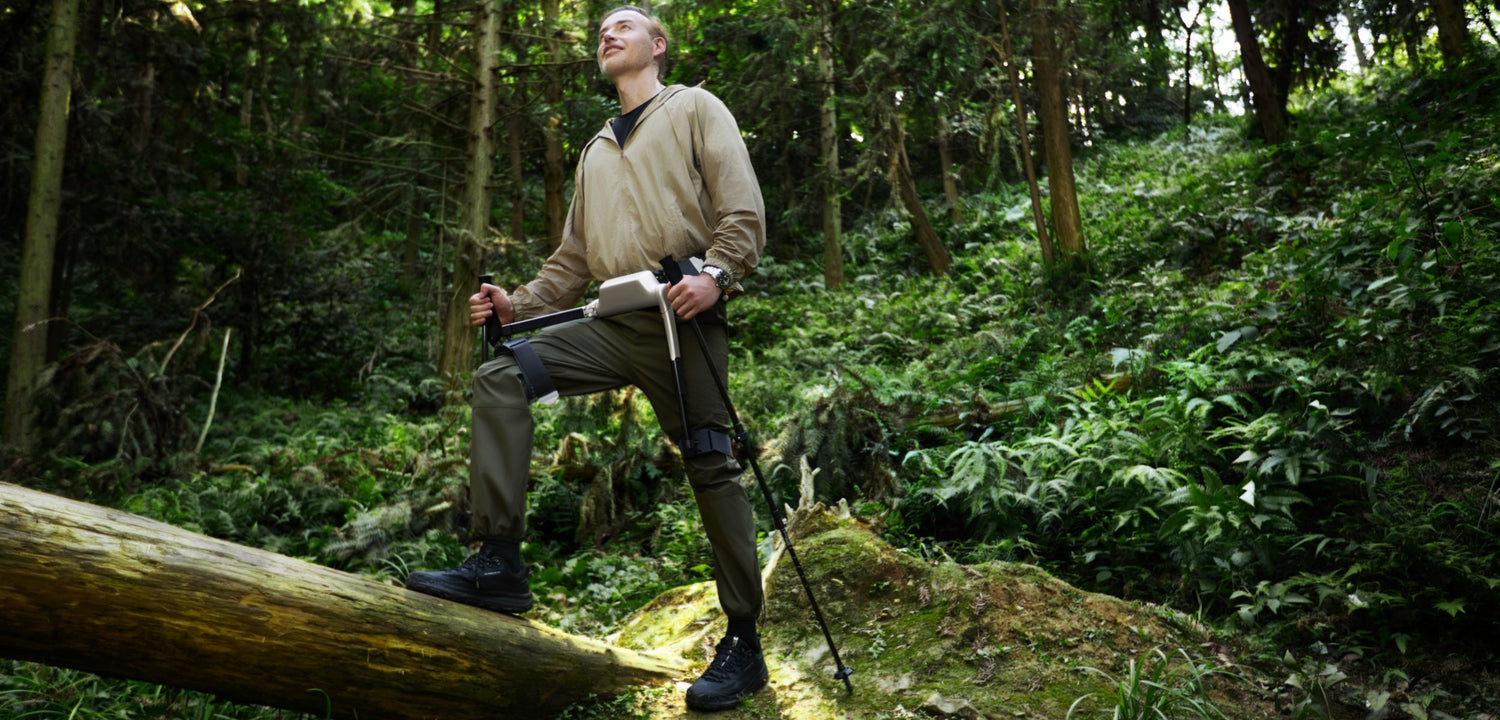
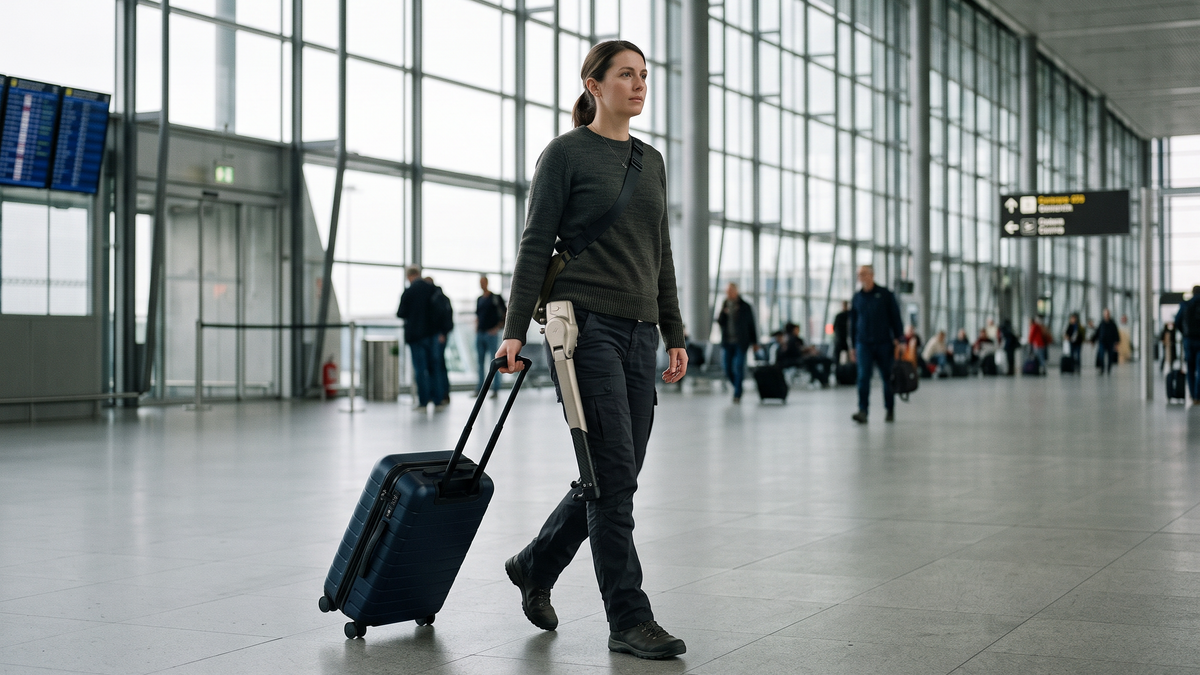
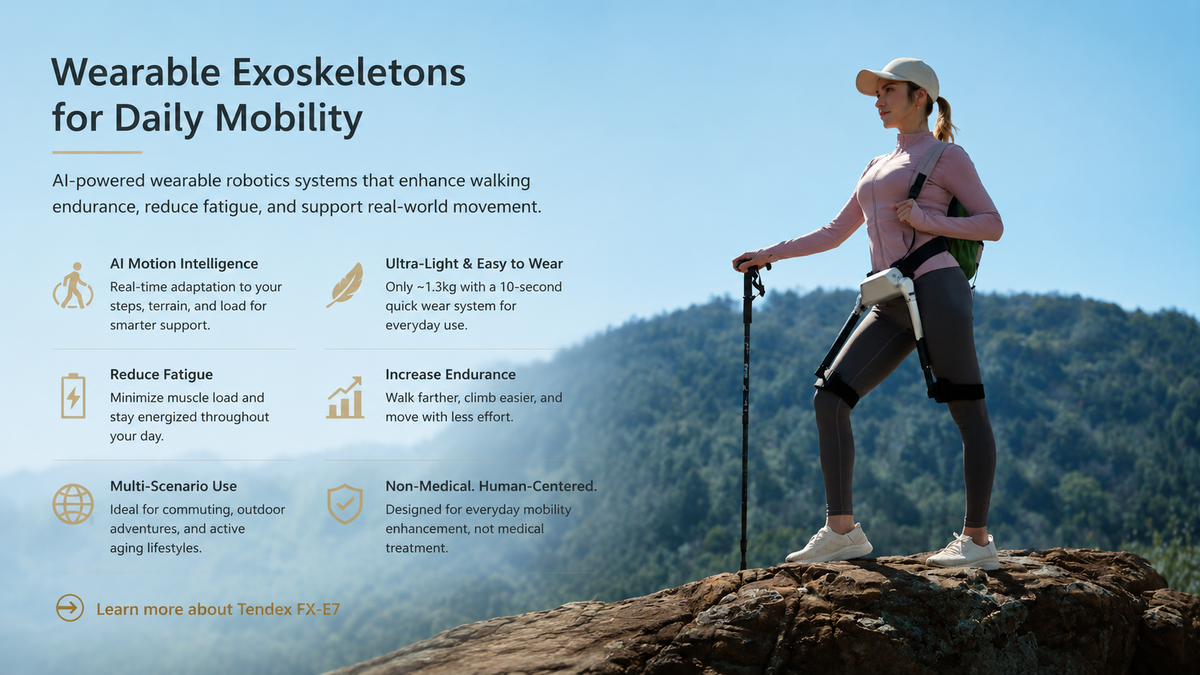
The TENDEX E7 is a hip-mounted walking exoskeleton built for exactly the constraint this post is about. Independent motors at each hip contribute force in the direction your leg is already travelling, so a kilometre costs you less than a kilometre.
The relevant behaviour is that it adapts. AI gait recognition identifies level walking, stairs, inclines, declines and running, and adjusts as the ground changes, which on a real day is constantly. Four modes let you take more support on the climb that would otherwise define your ceiling, and less on the easy ground where you do not need it.
It weighs approximately 1.3 kg, the lightest in its class. This matters more than a spec sheet suggests, because assistance that arrives attached to significant weight spends part of its own benefit before you take a step.
E7 City is built for pavement, transit, stairs and long urban days. E7 Explore is built for trails, sustained ascent and consecutive days out.

Leave a comment
This site is protected by hCaptcha and the hCaptcha Privacy Policy and Terms of Service apply.